Pricing guide
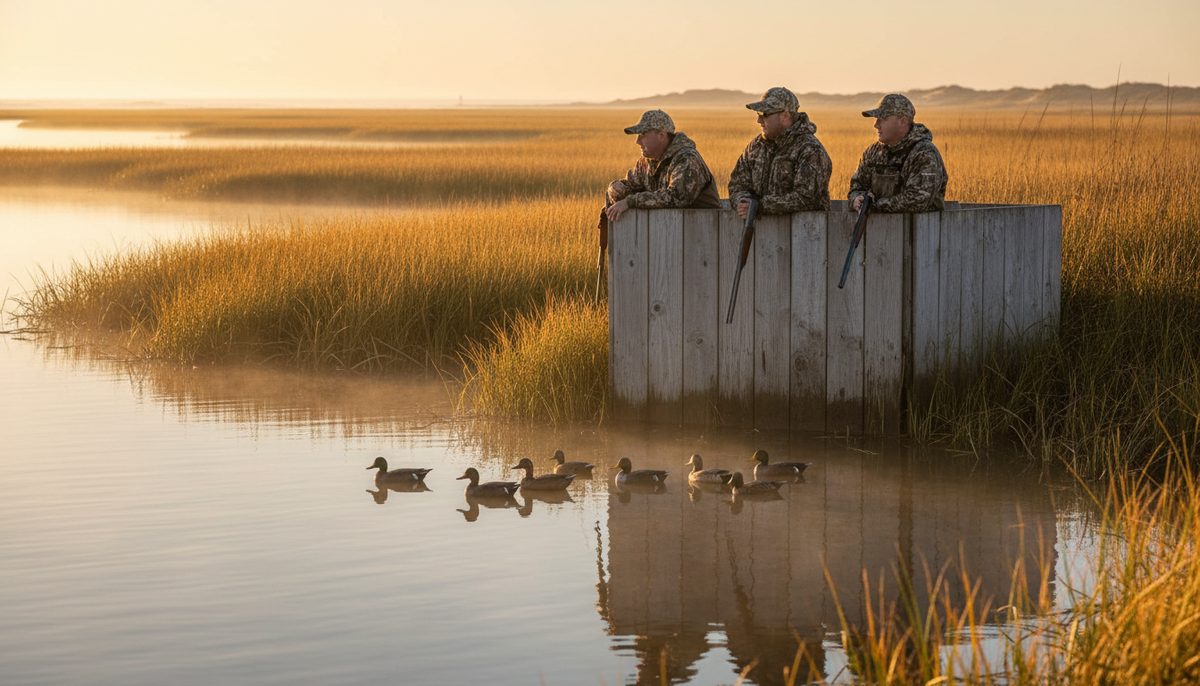
What a guided Outer Banks duck hunt costs
What a guided Outer Banks duck hunt costs, broken into the three layers that set it: what federal rule makes free, what the state charges you directly, and the guide fee the Park Service has to approve.
The figure this page is not going to print
Almost every page that answers this question opens with a dollar range, and almost none of them says where the range came from. We checked before writing this one, and there is no published, dated, authoritative rate for guided waterfowl hunting on the Outer Banks. The fact file behind this site records that absence on purpose: guide day rates were left out because no primary source states them. A number invented to fill the gap is the first thing a client later discovers was wrong, and we would rather be the site that says so.
What we can do instead is take the morning apart. A guided hunt here is assembled out of three layers, and the useful thing about them is that each answers to a different authority. One layer is written as free in federal regulation. One is priced by the state and paid by you, not by us. And one — the guide's own fee, if the hunt happens inside Cape Hatteras National Seashore — is not a free-market price at all.
Layer one: the parts documented at zero
Two costs people brace for turn out to be nothing, and both are in writing. Access to the Seashore hunting ground itself is the first: Seashore hunting privileges free with licence + stamp is the rule in 36 CFR 7.58, meaning no day-use charge, no per-blind levy and no access fee for anyone carrying the state licence and the federal stamp. Hunting ground that a private lease would price in the hundreds is, on this stretch of coast, a public resource with the gate open.
The second is HIP certification is free. Harvest Information Program certification is needed to hunt migratory game birds, it is issued at no charge, it may be obtained between July 1 and April 1, and it expires on June 30 each year. It is the item clients most often arrive without, precisely because it costs nothing and therefore feels optional — and it is the one that can end a morning before shooting light.
Layer two: what the state charges you directly
This is the layer that lands on your card rather than ours, and it is not negotiable by anybody. The requirement is NC waterfowl licence requirements: a hunting licence carrying the State Waterfowl Privilege, HIP certification, and — for waterfowl — a Federal Duck Stamp. The federal piece has an age threshold written into it, Federal Duck Stamp required age 16+, so the arithmetic for a party changes depending on who is in it; a fifteen-year-old in the blind is outside that particular requirement.
We are deliberately not quoting the fees. The state's fee tables did not render as text when this site's facts were verified against primary sources, so they were left out rather than recalled from memory, and a stale licence fee on a live page is worse than no fee at all. Buy from the Wildlife Resources Commission directly and you will see the current numbers at the moment you pay them.
There is one structural saving worth knowing before you buy, though, because it is documented: Sportsman licence includes State Waterfowl Privilege. The Comprehensive Hunting, Sportsman and Unified Sportsman licences already carry the State Waterfowl Privilege, while an annual Resident Hunt licence holder has to add it separately. If you hunt more than once a year in this state, the licence you choose at the counter quietly changes what the second trip costs.
Layer three: the fee a federal Superintendent has to approve
Here is the part of guided-hunt pricing that has no equivalent in most outdoor services. Inside the Seashore, the rule is Guides need NC guide licence + Superintendent permit: a guide may provide hunting guide service in the designated areas only while holding a North Carolina State guide licence and a permit issued by the Superintendent, the fees a guide charges must be approved in advance by the Superintendent, and guides may not solicit business within Seashore boundaries.
Read that again as a consumer protection rather than as red tape. The price of a guided Seashore hunt is not something an operator can decide on a busy weekend and raise at the ramp; it has passed through the Park Service before you were ever quoted it. It also means that anyone approaching you inside the park boundary with an offer of guiding is, by definition, doing something the regulation prohibits. The cheapest hunt on the beach and the legal hunt on the beach are not always the same hunt.
What actually moves a guide's number
Once the statutory and federal layers are set aside, what remains is the operation itself, and the drivers are physical. Water access is the largest: a blind you walk to and a blind that needs a shallow-draft boat launched in the dark are different mornings with different equipment behind them. The decoy spread is the second — a rig that looks right to birds working a sound in flat light represents real capital sitting in a trailer for eleven months a year, and it is set and picked up by hand in the cold on both ends of every hunt.
Dogs are the third, and the least visible. A finished retriever is years of work before it is an asset, and the difference it makes is measured in birds recovered rather than birds shot. The fourth is scouting, which is the part of the job the client never sees: the mornings spent watching where birds actually are this week, on this wind, rather than where they were last season.
Then there is the calendar, and this is the one a client can use. No migratory bird hunting on Sundays compresses every week of the season into six days, which concentrates demand on the same Saturdays every year. A weekday hunt in the middle of a season is a different conversation about availability than a Saturday in the opening fortnight, and guides will tell you so if you ask.
The ceiling the law puts on 'value'
Clients occasionally try to price a hunt per bird, and the regulation makes that arithmetic a bad idea before anything else does. The proclamation sets Daily duck bag: 6 — six ducks, and not six of whatever you like, because the sublimits inside that number are tight: no more than four mallards with no more than two hens, three wood ducks, three pintails, two redheads, two canvasbacks, two black ducks, one mottled duck, and the harlequin season closed outright.
A limit is a legal ceiling, never a forecast, and no honest guide on this coast will promise you one. What you are buying is a morning with the odds moved as far as scouting, position, calling and a good dog can move them — plus the certainty that everything done in that blind is legal, which is worth considerably more than it sounds when the alternative is a federal citation.
Four questions that make two quotes comparable
Ask each of them and the spread between two numbers usually explains itself. First: is this hunt inside the Seashore, on other public water, or on private ground, since the permitting behind each is different. Second: what is included — blind, decoys, calling, dog, boat, non-toxic shells — and what are you expected to bring. Third: how many guns does the quote cover, because blind occupancy is capped by regulation rather than by preference and a party of four may be two blinds. Fourth: what happens if the weather closes the water, and whether that is a reschedule, a refund, or a shortened morning at full price.
A guide who answers all four without hesitating is telling you what they will be like on the morning something goes wrong, and that is the part of the service you cannot see in a photograph.
Tell us the dates, the number of guns, and whether anyone in the party is under sixteen, and you will get a firm number for that morning — with the licence, stamp and HIP questions settled in the same conversation rather than at the ramp.
On the record: Guides need NC guide licence + Superintendent permit (eCFR — 36 CFR 7.58, Cape Hatteras National Seashore (law.cornell.edu, retrieved 2026-09-17)) · NC waterfowl licence requirements (NC Wildlife Resources Commission — License Types and Fees (ncwildlife.gov, retrieved 2026-09-17)) · Federal Duck Stamp required age 16+ (U.S. Fish & Wildlife Service — Buy a Duck Stamp or Electronic Duck Stamp (E-Stamp) (fws.gov, retrieved 2026-09-17)) · HIP certification is free (eRegulations (NCWRC official digital regulations) — Privilege Licenses, Stamps & Certifications (eregulations.com, retrieved 2026-09-17)) · Daily duck bag: 6 (NC Wildlife Resources Commission — 2025/26 Migratory Bird Seasons proclamation (ncwildlife.gov, retrieved 2026-09-17))
Hand-verified 2026-09-17 against the primary sources named above; where a fact could not be verified it was left out, never guessed.